
Clark VINELink Release Coverage
VINELink is the public entry to Kentucky VINE. It receives custody information from local jail booking systems and adult state correctional facilities. That makes it relevant to the Clark County Detention Center and KDOC. Some state offenders can have both a local-jail record and a DOC record, so matching identifiers may require checking both entries.
Coverage follows the legal custodian. VINE is not the Bureau of Prisons locator, the U.S. Marshals Service record route, or ICE’s locator. A departure from Clark CCDC to KDOC, USMS, or ICE is a transfer, not proof of return to the community. Search the receiving system when the source record points to another authority.
| Result or field | How to read it |
|---|---|
| Name and offender ID | Identity clues that must be checked with birth date and facility facts |
| Custody status | The system’s reported status at the time checked |
| Facility | The reporting jail or institution, not always the final legal custodian |
| Not in custody | A released result that may include a release date; confirm it elsewhere |
| Release date | The reported event date, not a promise about current location |
| Notify Me | Registration route for offered status-change alerts |
Search Clark Inmates on VINELink
A one-person search is strongest when the legal name is paired with an offender number, birth date, or known facility. Common names and duplicate jail/DOC records can produce the wrong match. Preserve the exact wording and check time, since status can change after the screen is opened.
- Visit VINELink and select Kentucky.
- Choose Find an Offender.
- Enter a partial legal name or offender ID. Use birth date, identifiers, and facility facts to separate matches.
- Open the matching record. If held, read the reported jail or institution. If it says not in custody and gives a date, record both.
- Search for a second local or DOC record. A local release plus a DOC location usually points to transfer.
- Cross-check a Clark jail event with CCDC or the court. Check a state event in KOOL or the KDOC Daily Releases archive.
The broader Clark County released inmate search explains the other systems when VINE has no match. No result can reflect spelling, incomplete data, a different custodian, or a record outside VINE’s scope.
Register Clark County Release Alerts
Registration begins on the correct offender record. Kentucky materials describe telephone, email, text, TTY, and in-app channels, but the choices displayed for a specific record control. Select only the events and channels the system offers. Contact information should be entered where the intended recipient can receive and acknowledge the notice.
- Open the verified record and choose Notify Me of Status Changes.
- Select the offered custody, transfer, or release events and delivery method.
- Enter the contact destination. Kentucky guidance permits more than one contact, including two phone numbers.
- For phone calls, create a memorable four-digit PIN. Avoid a line answered by a switchboard.
- Save the confirmation. Enter the PIN during a call to acknowledge the notice and stop repeat calls.
- For help, call Kentucky VINE at 800-511-1670 or TTY 866-847-1298. KDOC VINE help is 502-564-5061 or 877-687-6818.
The Kentucky Attorney General VINE page gives the state’s official phone registration and alert guidance. The Enhanced VINE brochure describes the available communication channels and PIN process.
Clark VINELink Alert Timing
For a local jail release, Kentucky guidance says phone calls can repeat every 30 minutes for up to 24 hours or until the PIN is entered. Scheduled release notice from a state institution is attempted 72 hours in advance. Some court-ordered, parole, immediate-credit, and escape events can be sent only after the source agency reports the event. Email or text delivery can also depend on vendor and carrier processing.
An alert is a prompt to verify. It is not a guarantee of physical safety, present location, or final discharge. The Attorney General warns against relying on VINE alone. A person can also leave one facility for another without entering the community.
Two-Source Clark Release Checks
KDOC documented a 2026 vendor problem that produced false release alerts. That event does not make VINE unusable. It shows why a notification and an agency record serve different roles. The notice supplies speed. The custodian’s corrected status, actual-release report, or signed court order supplies confirmation.
For a Clark County jail record, call CCDC at 859-745-0270 and identify the person and booking when possible. A court bond or disposition order can confirm legal authority, though the order time may differ from physical departure. For a state offender, open KOOL, compare the DOC number, and consult KDOC Daily Releases for the date, type, and releasing facility. The official KDOC VINE information page preserves the vendor-error notice and state guidance.
Write down the alert time, the status displayed later, and the confirmation source. If the records conflict, describe the conflict instead of choosing the result that arrived first.
Clark VINELink Status Limits
VINE reports custody data supplied by participating agencies. It does not decide a court case or compute final discharge. A “not in custody” result can be useful because Kentucky VINE may also provide a release date, but it does not establish whether parole, probation, another warrant, or another agency’s hold applies.
Federal sentenced inmates use the BOP locator. Federal pretrial detainees under USMS lack an equivalent public person locator and may require the federal docket, housing facility, or a narrow records request. ICE’s system covers current detainees and people released from ICE custody within the prior 60 days. These boundaries prevent a Clark County VINELink record from being stretched beyond its source.
For projected dates rather than actual events, use Clark County Inmate Release Date. A projected date can move and should not be registered or repeated as if it were a completed release.
A Kentucky sex-offender registry record is also a separate legal record. Registration status does not operate as a general release list, and it should not be used to fill a gap in VINE. Search that registry only when the person is subject to its governing law and the question concerns the published registry entry.
Alerts do not disclose a person’s safe present location. They also cannot replace emergency planning or direct contact with law enforcement when there is an immediate risk. Kentucky’s official warning is practical: use the notification as a prompt, keep the PIN private, and verify the event with the reporting custodian.
If a phone call repeats, entering the correct four-digit PIN acknowledges it. Email, text, TTY, and app notices may follow different delivery paths. Save registration confirmation so support staff can trace the chosen record and channel.
Clark VINELink Identity Checks
Names are not unique identifiers. Compare the full name, birth date when available, offender number, facility, and known case facts. A middle name, suffix, or alias can separate people who look alike. If those facts do not align, do not register on that record. Return to the results and test another spelling or identifier.
Duplicate entries have a special meaning in Kentucky. One can originate with a local jail while a second belongs to KDOC. Registering on both matching records can prevent a transfer from looking like release, but two notices may describe different stages of one custody path. Save each record number and reporting agency.
The official VINELink Kentucky screen shows where the Clark County check begins.
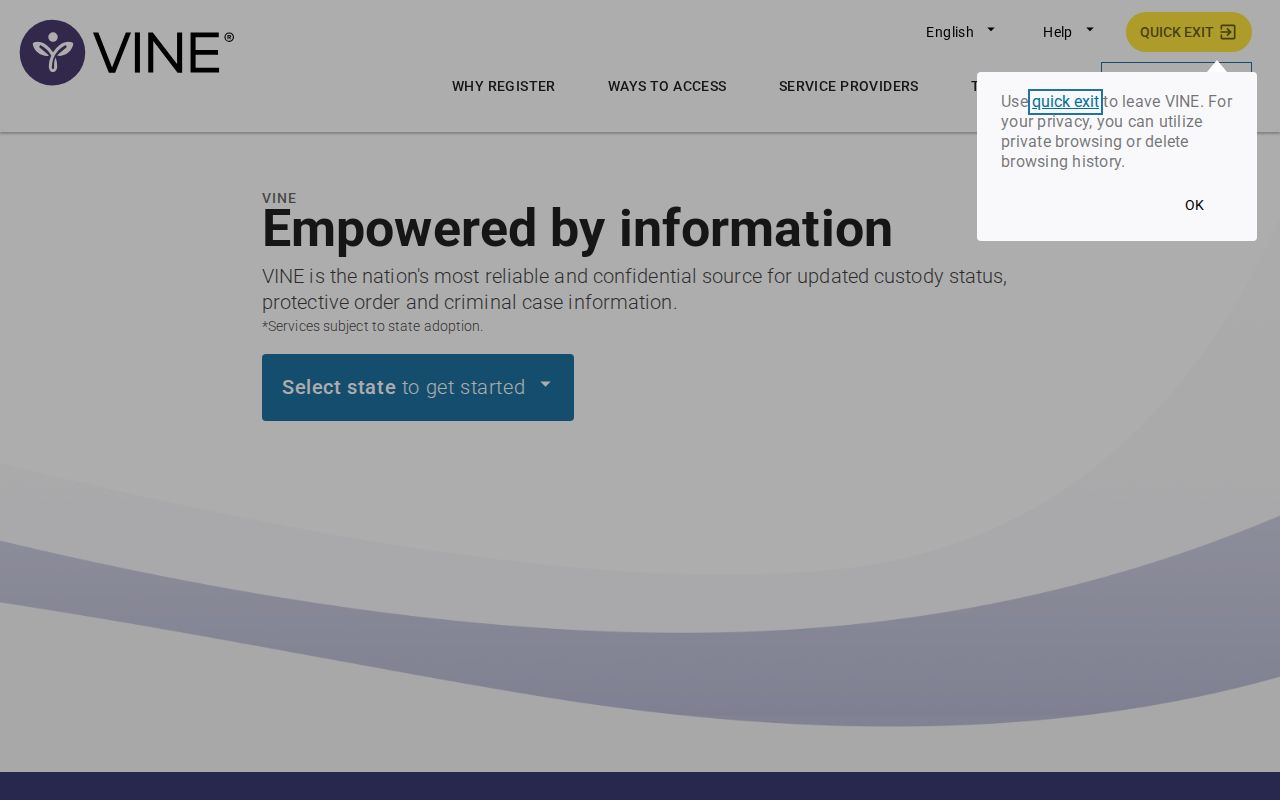
The screen leads to the one-person custody result and notification workflow.
Clark Duplicate VINE Records
Kentucky guidance notes that one person may have a local-jail record and a KDOC record. They can represent two stages of custody. Match the name, birth facts, offender number, and facility before treating them as the same person. Registering on both matching records may help when someone moves from Clark CCDC into state custody.
Read each alert against its source. A local record saying not in custody can coexist with a DOC record naming a state institution. That points to transfer, not community release. If both show release, compare the dates and types with KOOL and Daily Releases. Keep each record number so a correction can be traced.
No match can reflect spelling, incomplete data, or another custodian. Try a partial legal name and known ID. Never turn a blank result into a release finding.
Follow Up Clark Release Alerts
For a Clark jail alert, record the displayed name, identifier, event, facility, alert time, and any date. Then contact CCDC or check the court case. The court order establishes legal authority for bond, dismissal, probation, or another action. The jail record documents processing and departure. Those times can differ.
For a KDOC alert, search KOOL by DOC number. Read status, supervision location, sentence facts, and dates. Next, open the date-specific Daily Releases report and locate the DOC number, release type, and released-from facility. Parole means custody ended under conditions, not that the sentence vanished.
If the sources conflict, call the reporting agency. State what VINE reported and what the source later confirmed. Do not claim final release while the conflict remains.
Clark VINE and Court Events
VINE can send an event only after the source agency transmits it. Court-ordered release, parole, immediate-credit, and escape notices may arrive after legal action or processing begins. The signed order, jail record, and notice therefore answer related but different questions.
Guest CourtNet can identify the Clark case number and event sequence. The clerk supplies the signed order. District handles misdemeanors and early felony proceedings; an indicted felony continues in Circuit. Check the right division before deciding that no release order exists.
Public Record Search
Sponsored Results